
Roblox paid creators $922 million in 2024. Fortnite paid another $352 million. Numbers like these have fueled one of gaming’s biggest assumptions: the future belongs to creator platforms.
If creator-driven ecosystems are growing this fast, shouldn’t the rest of the industry be moving in the same direction? To find out, the 51 Games research team analyzed 23 major gaming companies, evaluating their creator tools, monetization systems, marketplaces, modding support, and creator programs.
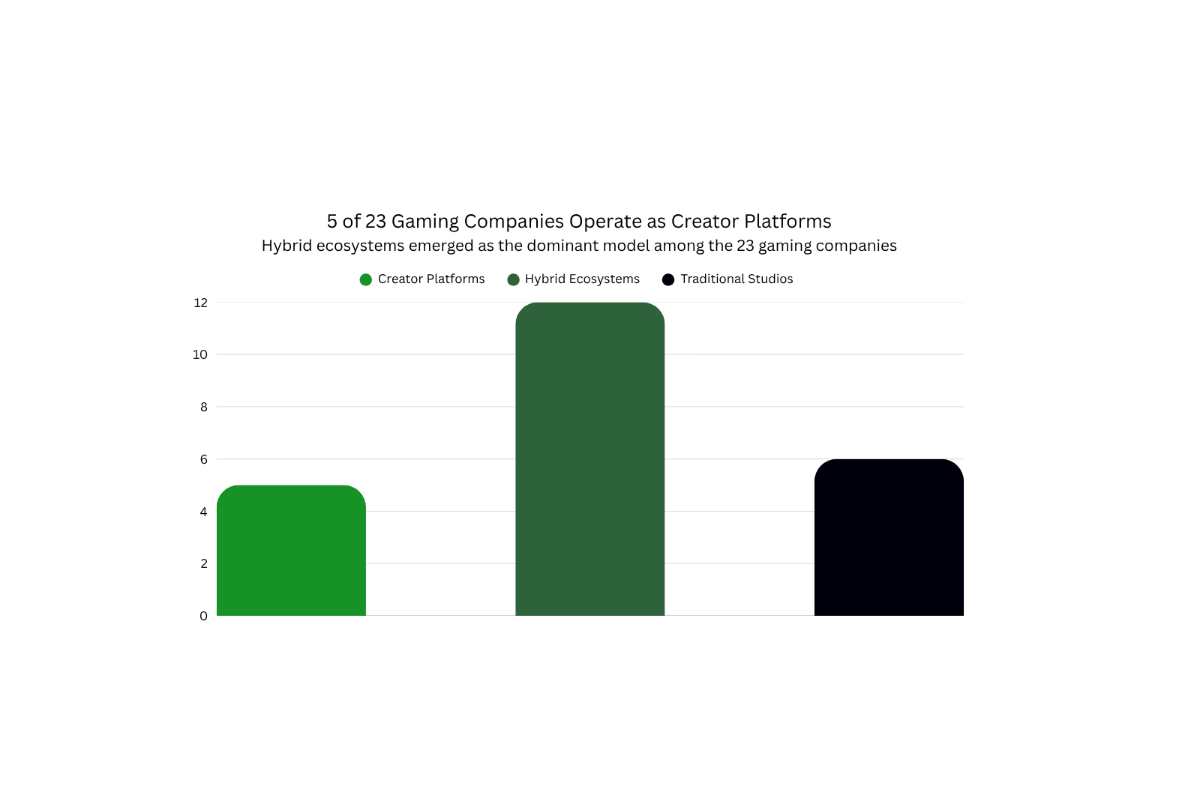
The results challenge the industry’s dominant narrative. While creator-economy features are spreading across gaming, only 5 of the 23 companies we studied operate as true creator platforms. Most are building something different: ecosystems that combine professional game development with creator participation.
23 Companies, One Question: Is Gaming Actually Becoming Platform-First?
Roblox and Fortnite have become two of the most influential success stories in gaming. As a result, creator platforms are often presented as the industry’s next evolution.
The assumption is straightforward: if creator-driven ecosystems are generating hundreds of millions of dollars for creators and attracting millions of players, other gaming companies will eventually follow the same path. But assumptions are not trends.
We wanted to understand whether major gaming companies were actually rebuilding their businesses around user-generated content or whether the success of creator platforms was creating a perception that did not reflect what the broader industry was doing.
Only 5 of 23 Companies Qualify as True Creator Platforms
We classified companies into three categories: creator platforms, hybrid ecosystems, and traditional studios, based on how they support content creation, distribution, and monetization.
The distribution revealed a clear pattern.
Hybrid ecosystems emerged as the dominant model, accounting for more than half of all companies analyzed. Rather than fully embracing user-generated content as the foundation of their business, these companies are selectively integrating creator-economy features while continuing to invest in professionally developed games.
70% of Gaming Companies Support Creator Tools, Yet Only 22% Operate as Creator Platforms
The creator economy is spreading across gaming much faster than the creator-platform model. Our research found that 18 of 23 gaming companies support at least one creator-economy feature, while only five operate as true creator platforms.
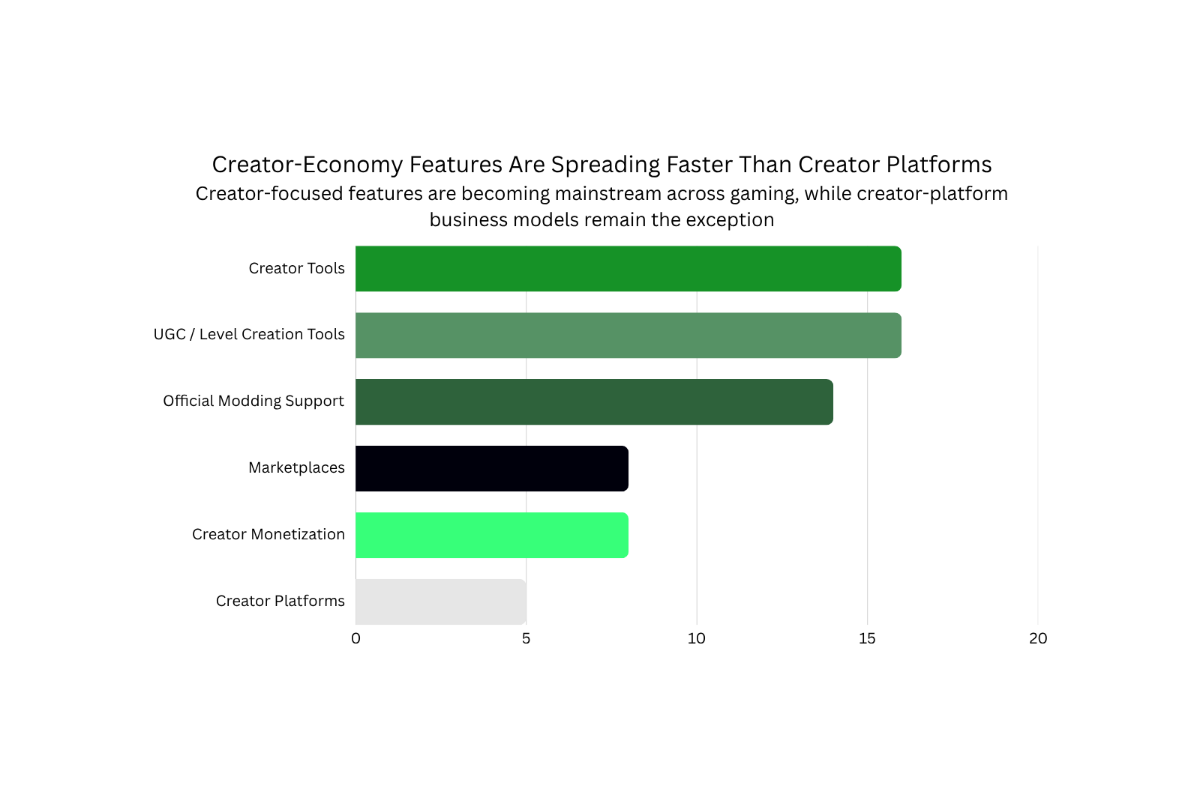 Creator-focused features appeared across much of the industry. Creator tools and user-generated content systems were present in 16 of the 23 companies analyzed, while official modding support appeared in 14.
The Industry Is Building Ecosystems, Not Platforms
The dominant industry narrative suggests that creator platforms represent the future of gaming. Our data does not support that conclusion.
What is spreading across the industry is not the creator-platform model itself, but the individual features behind it. Creator tools, modding support, marketplaces, and creator programs are becoming increasingly common, while fully creator-driven business models remain the exception.
The companies shaping gaming’s future are not becoming the next Roblox. They are selectively adopting the features that made Roblox successful.
The future of gaming is not platform-first. It is ecosystem-first.