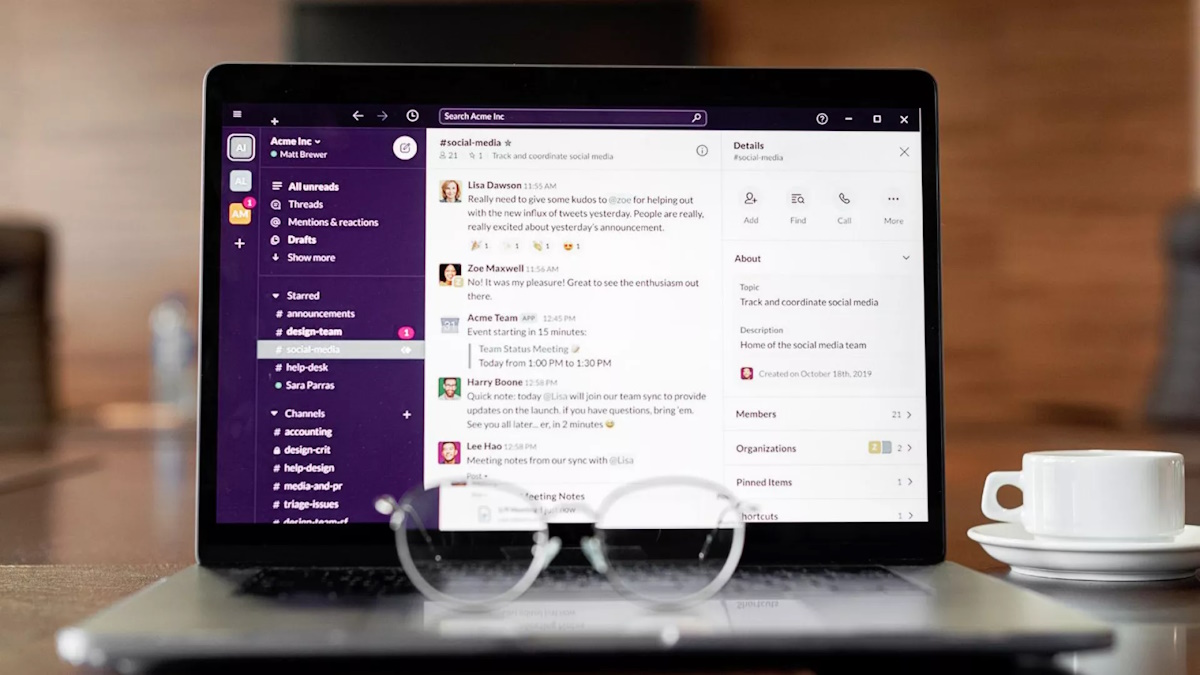
Slack has recently faced criticism regarding its data usage policies, prompting the company to clarify its practices.
As a widely-used workplace communication platform owned by Salesforce, Slack saw increased usage during the COVID-19 pandemic due to the shift to remote work. However, controversy arose when a user highlighted Slack’s privacy principles, which state that the platform analyzes customer data—such as messages, content, and files—along with usage information to develop non-generative artificial intelligence (AI) and machine learning models.
Responding to concerns on the social media platform X (formerly Twitter), Slack clarified that their AI models are not designed to learn, memorize, or reproduce customer data. Additionally, Slack assured users that their data is not used to train third-party large language models (LLMs). The company does employ machine learning for features like summarizing information from followed channels.
In response to the backlash, Slack published a blog post acknowledging the feedback and admitting that their privacy principles might not have been sufficiently clear, potentially leading to misunderstandings about data usage. The company emphasized that it uses de-identified, aggregate data for traditional machine learning models, which do not access message content in direct messages (DMs), private channels, or public channels.
Contacted by Euronews Next, Slack provided examples of customer data usage, such as timestamps of the last messages sent in channels, interaction counts between users, and overlapping words in channel names to indicate relevance to users. While the guidelines themselves have not changed, the confidentiality principles have been updated for better clarity.
The opt-in-by-default approach, where data usage is automatically enabled unless opted out by an IT administrator, has been a point of criticism. Slack’s blog post also noted that administrators could email customer service to opt out of data usage.
Concerns about AI and data privacy are growing, especially regarding large language models. Companies like Google and Amazon have reportedly advised employees against inputting confidential information into generative AI tools, highlighting the broader industry concerns about data privacy.
Slack’s recent updates aim to address these concerns and provide more transparency around its data usage practices.
Source: euronews.com