
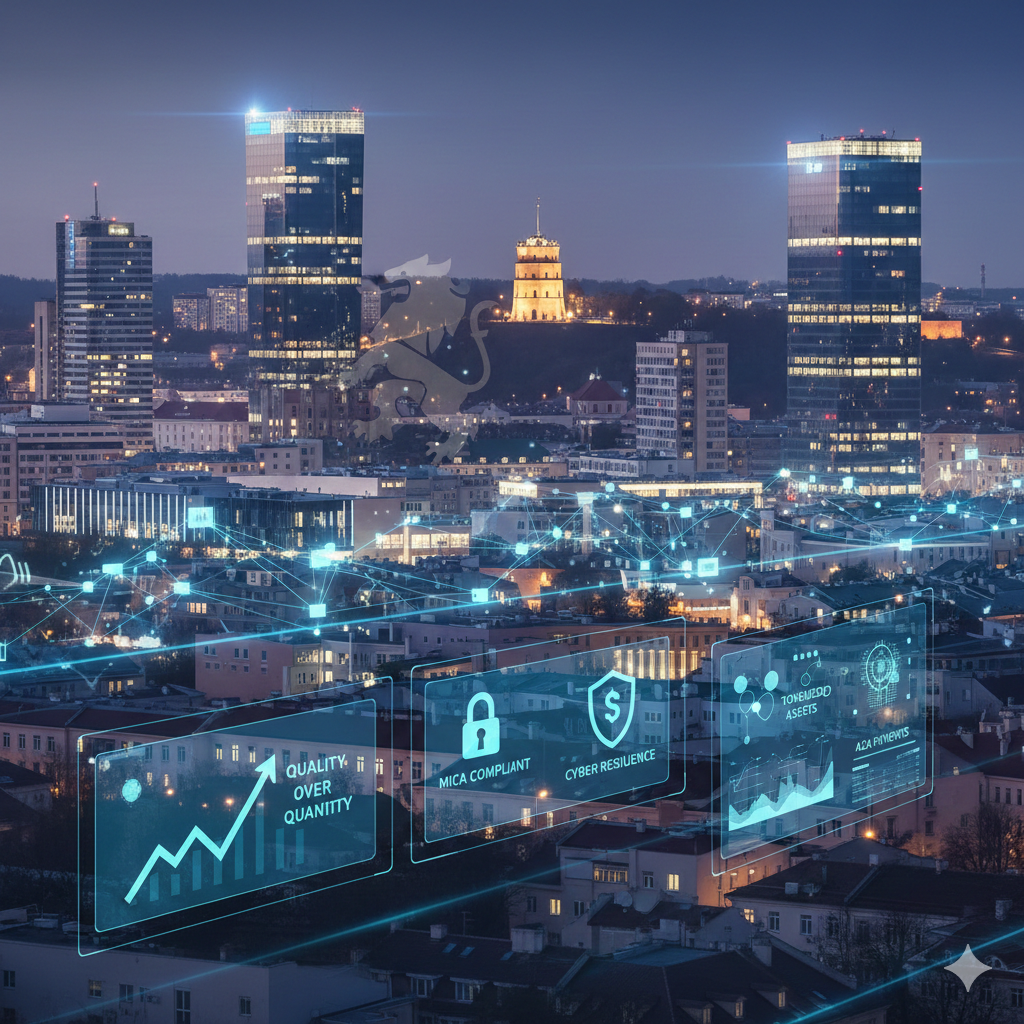
In the early days of the fintech boom, Lithuania was known for its agility and low barriers to entry. However, as we move through early 2026, the narrative has shifted. The “Regulatory Cleanup” is complete, and Vilnius has officially transitioned from an easy-access licensing hub to a high-standard “quality over quantity” ecosystem.
For CEOs, compliance officers, and investors, navigating this new landscape requires more than just a license—it requires operational resilience. Here is the state of the market across the four pillars of Lithuania’s digital economy.
1. Banking: The Specialized Revolution & Cyber Stress Tests
The banking sector is no longer a playground for a few dominant Nordic players. The “RATO Shift” has signaled a new era where local credit unions are successfully transitioning into specialized banks. As of January 2026, RATO bankas has led this charge, proving that domestic players can compete on a tier-one level.
However, with new status comes new scrutiny. The Bank of Lithuania (Lietuvos bankas) has introduced rigorous Cyber Resilience Stress Testing. In 2026, a bank’s health is measured not just by its capital adequacy, but by its ability to maintain service continuity during a simulated Tier-1 digital attack.
2. Fintech: Scaling Beyond the Baltics
Lithuania remains a top-tier European fintech hub, but the focus has moved from attracting startups to scaling them. The national 2023–2028 Fintech Strategy is now in its high-growth phase, with a heavy emphasis on:
-
Account-to-Account (A2A) Payments: Reducing reliance on global card schemes to foster a more autonomous European payment rail.
-
B2B Market Expansion: Firms like myTU and Revolut are utilizing their Lithuanian regulatory “passport” to dominate the German and UK B2B sectors.
-
The Rise of Agentic AI: 2026 is the year of the AI Agent. Fintechs are moving past simple support bots to autonomous agents capable of handling complex AML reconciliation and credit scoring without human intervention.
3. Blockchain: The Post-MiCA “Great Consolidation”
The “Wild West” era of Lithuanian crypto officially ended on January 1, 2026. With the full implementation of the EU MiCA (Markets in Crypto-Assets) Regulation, the number of registered crypto firms has consolidated significantly.
To survive in 2026, Virtual Asset Service Providers (VASPs) must meet two non-negotiable standards:
-
Local Substance: A mandatory, locally-based AML officer who is a resident of Lithuania.
-
Capital Requirements: A fully paid-up share capital of at least €125,000.
This regulatory clarity has paved the way for Institutional Asset Tokenization. Major banks are no longer shying away from blockchain; instead, they are actively piloting tokenized bonds and stablecoin settlement layers.
4. iGaming: Building a “Digital Fortress”
Lithuania now boasts some of the strictest iGaming protections in the world. The hot topic of 2026 is the Advertising Ban. As the industry moves toward a total phase-out by 2028, operators are forced to ditch aggressive “bonus-led” marketing in favor of Brand-Centric Marketing.
To combat the black market, the government has empowered regulators with ISP Fast-Track Blocking. Illegal operators are now identified and blocked within hours, not weeks. This “Digital Fortress” approach ensures that only highly compliant, licensed operators—those investing heavily in identity verification technology—can thrive.
Conclusion: The Resilience Premium
In 2026, the “Lithuanian Advantage” is no longer about how fast you can get a license, but about the Resilience Premium—the trust that comes with operating in one of the world’s most rigorously supervised jurisdictions.
For those who can meet the high bar of the Bank of Lithuania and the FNTT, the rewards are clear: a stable, prestigious home base with full access to the European Single Market.
Join the Conversation at HIPTHER Baltics: Vilnius
The future of the Baltic digital economy isn’t just being written—it’s being debated, regulated, and built right now. Whether you are navigating the post-MiCA landscape, scaling a B2B fintech, or pivoting your iGaming strategy, there is only one place to be for the most direct insights and elite networking.
Don’t just watch the “Regulatory Cleanup” from the sidelines—be part of the elite ecosystem.
Why Meet Us at HIPTHER?
-
Direct Access: Connect with the regulators and innovators mentioned in our 2026 agenda.
-
Deep Dives: Move beyond the headlines into the technical and legal realities of Cyber Stress Tests and A2A payments.
-
Strategic Networking: Build the partnerships that will define the “Quality over Quantity” era.
Secure your pass now and lead the transition in the Baltics.