
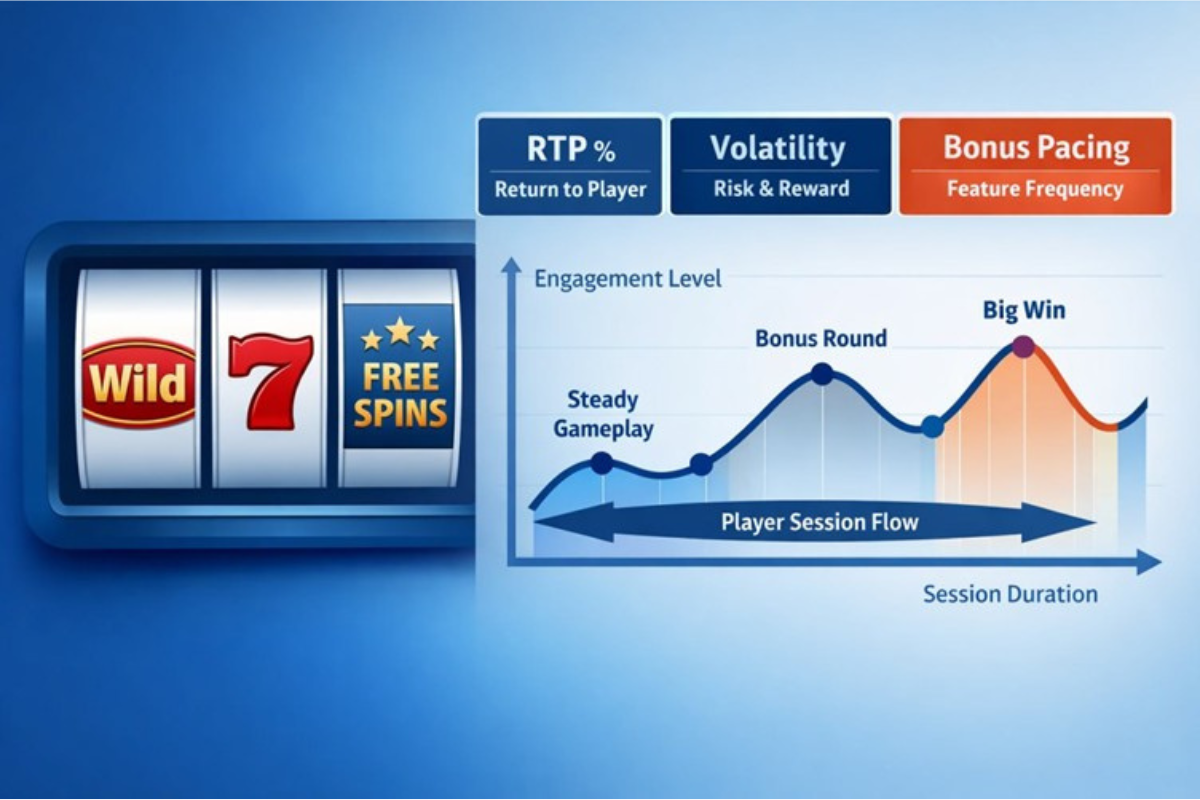
Online slots have evolved far beyond simple reel mechanics. Today’s leading games are built around retention-driven design systems that borrow heavily from mobile gaming, behavioral analytics, and user experience optimization. While RTP and volatility remain essential mathematical pillars, player retention is now shaped just as much by feature pacing, game flow, and visual reward systems.
At a surface level, slot games still appear simple: spin the reels and wait for an outcome. But beneath that simplicity, modern slot development has become significantly more sophisticated.
Over the past decade, online casino operators and software providers have increasingly focused on the same challenge that dominates much of digital entertainment: keeping users engaged over longer sessions without making the experience feel repetitive.
This has changed the way slot games are built.
Today’s most successful titles combine mathematical balance with progression-like features, visual stimulation, and variable reward pacing that feel more aligned with digital gaming products than traditional mechanical casino machines.
File name: online-slot-retention-design-analysis.png Alt text: Modern online slot design infographic showing player retention mechanics, RTP, volatility and bonus pacing
The Shift from Basic Spins to Structured Engagement
Early online slots relied mostly on recognizable themes and simple bonus mechanics.
Modern slot titles are different. Developers now layer in:
- multi-stage bonus rounds
- cascading reels
- expanding wild systems
- persistent feature triggers
- more dynamic audiovisual feedback
These systems do more than create excitement. They make the experience feel more interactive and less repetitive across longer sessions.
For operators, this matters because longer engagement often translates into stronger player retention. Games that feel “alive” keep users active longer than titles that repeat the same outcome loop without variation.
Why Retention Design Matters in iGaming
Player retention is one of the most important commercial variables in online gambling.
Acquisition costs continue to rise, particularly in competitive markets, which means operators are under growing pressure to improve lifetime value through product experience.
Slot design plays a major role in that process.
Retention is shaped by several game-level variables:
- how often bonus features trigger
- how visually rewarding wins feel
- whether the game has a clear rhythm
- whether sessions feel stable or overly punishing
Volatility also plays a key role. Lower-volatility titles tend to support longer sessions through smaller, more frequent rewards, while higher-volatility titles appeal to players who prefer larger swings and more dramatic outcomes.
The key point is that mathematical design and entertainment design now work together much more closely than they once did.
RTP, Volatility, and Content Depth
While engagement systems matter, the mathematical foundations of slot design still shape the overall product.
RTP remains one of the most important reference points for experienced players because it reflects the long-term payout model built into the game. Volatility then determines how that return is distributed across actual sessions.
Operators are increasingly aware that players are becoming more informed about these concepts.
Research into payout structures, slot variety, and game selection published in SlotsCanada’s real-money slots guide shows how operators increasingly balance high-engagement design with broader slot library depth for Canadian players.
This reflects a broader trend across the sector: players are not only choosing games based on theme or brand familiarity, but also on how different slot products feel over time.
The Influence of Mobile Game Design
One of the clearest influences on modern slots is mobile game design.
Many slot developers now use systems that mirror mechanics found in casual and mobile gaming, including:
- escalating anticipation
- dynamic animations
- timed reveals
- feature-based progression loops
These systems are designed to sustain emotional engagement without requiring skill-based gameplay.
That is especially important in regulated online casino environments, where game integrity must remain mathematically controlled while still competing for player attention in a crowded entertainment market.
The Future of Slot Product Strategy
Going forward, the distinction between casino game design and broader digital product design will continue to narrow.
Operators and studios are already investing more heavily in:
- product personalization
- data-informed game deployment
- UX-driven lobby design
- retention-friendly feature sequencing
The result is a more polished and strategically designed slot ecosystem where product design has become just as important as game mathematics.
For the iGaming industry, this is an important shift. The future of successful slot products will depend not just on jackpots or themes, but on how effectively games combine mathematics, pacing, and user experience to retain players over time.
Final Thoughts
Modern slot design is no longer just about reel outcomes and symbol combinations.
It is about balancing mathematical fairness with engagement architecture sophisticated enough to compete in a broader digital entertainment environment.
As competition within iGaming continues to increase, the operators and studios that understand this balance best will likely have the strongest retention performance in the years ahead.