
By Karym Abdelrakhman, CEO of Simplify Labs
Crypto adoption is finally reaching the real economy. Visa has reported billions of dollars in spending through crypto-linked card programs, while Mastercard continues expanding partnerships with blockchain platforms to support stablecoin and digital asset payments. Wallets that once served primarily as trading accounts are gradually becoming spending accounts.
The question for fintech companies is no longer whether crypto payments will arrive. It’s how quickly they can launch them.
One of the most visible bridges between crypto and real-world finance is the crypto card. A card program allows users to spend digital assets anywhere traditional payment networks operate, converting crypto balances into fiat at the point of sale. For exchanges, fintech apps, and Web3 platforms, this creates an immediate connection between wallets and everyday commerce.
Yet launching such a program historically required significant technical coordination. A typical crypto card rollout involved:
- integrating custody systems,
- establishing partnerships with card issuers,
- implementing compliance and KYC workflows,
- connecting fiat on-ramps and off-ramps,
- managing liquidity,
- and building transaction monitoring infrastructure.
Each element often came from a different vendor, and integration timelines could stretch from six months to a year. However, the demand for crypto payments existed long before the infrastructure caught up. What the industry lacked was modularity.
This is where the market is shifting today: crypto has entered the plateau of productivity. As the industry matures, and growth is increasingly driven not by narratives or speculative cycles, but by platforms capable of handling real usage and sustained transaction volume.
We at Simplify Labs see this shift across the ecosystem. Exchanges are evolving into full financial platforms. Stablecoins are emerging as settlement rails for cross-border payments. On-ramps and off-ramps are integrating directly into fintech apps. Crypto wallets are beginning to function as everyday spending accounts.
In other words, crypto is starting to resemble fintech. And fintech runs on infrastructure. When infrastructure becomes modular, the competitive variable changes. Instead of months-long development cycles, companies begin competing on speed to market.
Crypto cards illustrate this transformation clearly: a card program instantly connects crypto balances to global payment networks, allowing digital assets to function as a usable financial tool rather than a static store of value.
For businesses, the impact is straightforward: exchanges gain stronger user retention when customers can spend assets directly; fintech platforms unlock additional revenue streams through payment processing; web3 projects gain real-world utility for their ecosystems.
But the biggest shift is operational.
When infrastructure becomes modular and integrated through unified gateways, launching crypto payment capabilities becomes dramatically faster. Instead of coordinating multiple vendors and development cycles, platforms can integrate a complete payment stack through a single system. At the same time, as transaction volumes increase and payment flows become continuous, reliability becomes more important than experimentation.
This is where a reliable partner is needed.
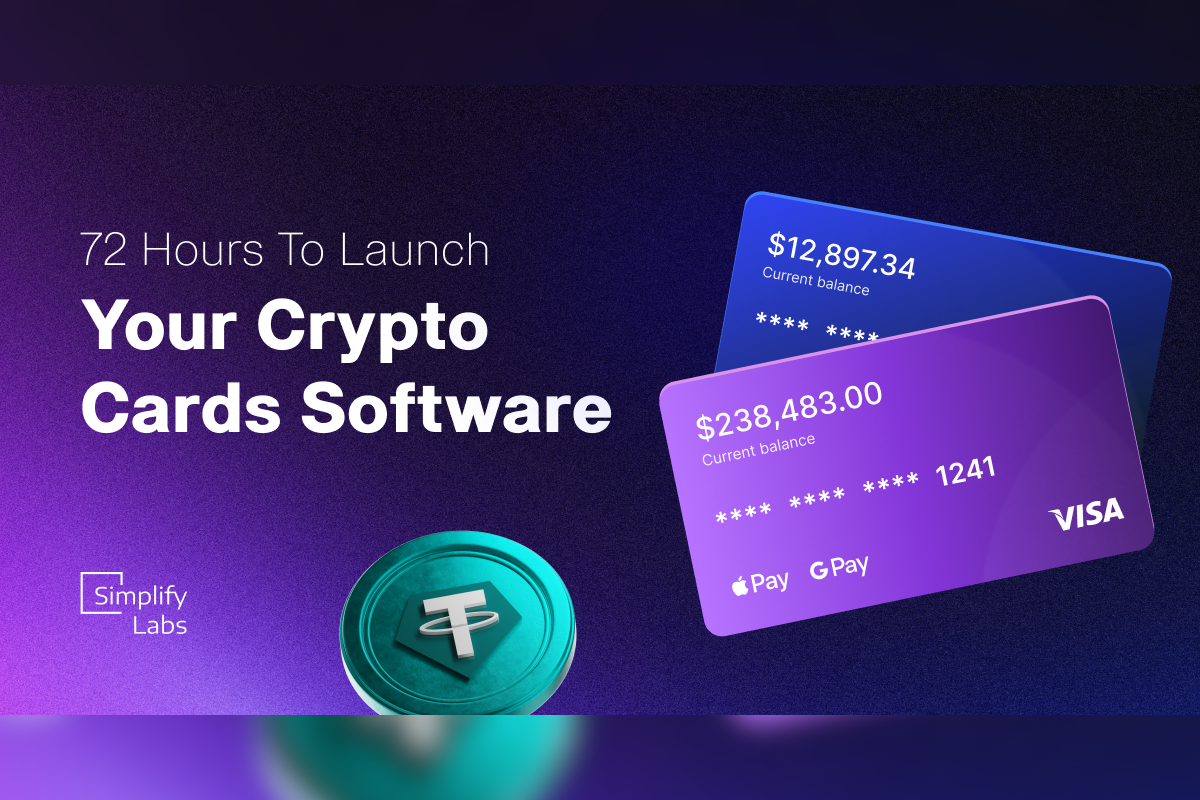
Simplify Labs’ software for crypto cards makes it easy for businesses to launch and scale crypto payments. The solution can be deployed in as little as 72 hours, offers a simple user experience with instant card issuance, and supports both Apple Pay and Google Pay.
With Visa worldwide coverage, fast crypto conversion, flexible pricing, and unlimited card issuance, it enables its partners to build high-margin payment products. Already used by 10+ active clients with over $1M in processed volume, the software combines speed with strong security – including encryption, 2FA, fraud detection, and blockchain monitoring.
After all, launching new financial products no longer requires rebuilding the underlying systems each time. Instead, companies can focus on user experience and product design.
And when that happens, deploying crypto-powered financial services becomes a matter of days rather than months.